AI Agent vs Chatbot: What's the Difference in 2026?
If you have ever used a website chat widget that answered a basic question or helped you track an order, you have interacted with a chatbot. If you have used a system that researched information across multiple sources, scheduled a meeting on your calendar, and updated your CRM without you lifting a finger, you have experienced an AI agent.
These two technologies get lumped together constantly, but they are fundamentally different in what they can do for your business. With Gartner predicting that 40% of enterprise applications will include task-specific AI agents by 2026 and 60% of customer service leaders feeling pressure to adopt AI (Gartner), understanding this distinction is no longer optional. It directly affects how you automate workflows, serve customers, and generate revenue.
This guide breaks down the real differences between AI agents and chatbots, explains when to use each, and shows how the best platforms in 2026 combine both to deliver results that neither could achieve alone.
Key Takeaways
- Chatbots respond to prompts and follow scripts. AI agents pursue goals, make decisions, and execute multi-step tasks autonomously.
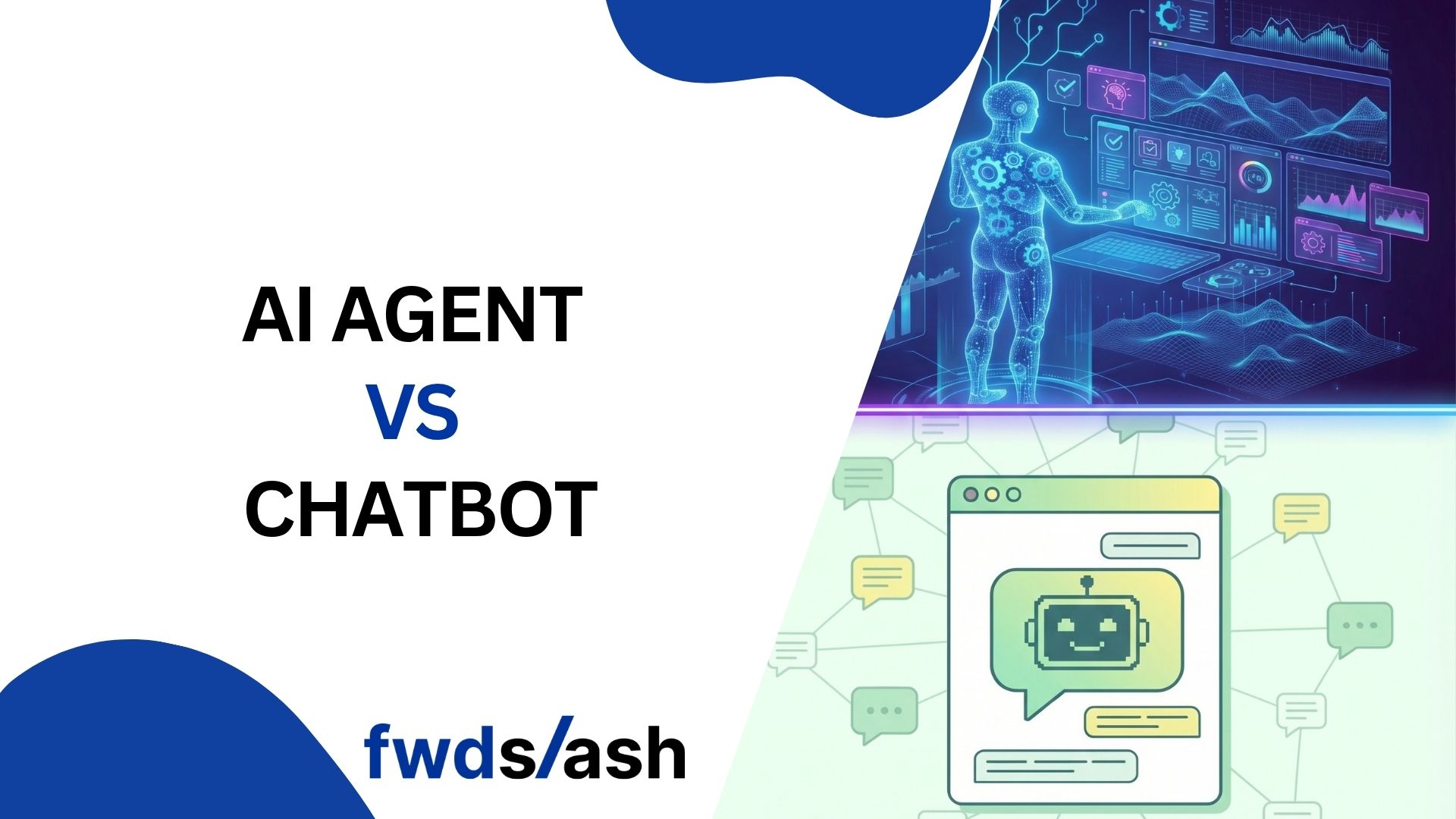
- The simplest distinction: chatbots communicate, AI agents act.
- 84% of developers now use AI tools, and eight in ten enterprises have deployed agent-based AI, signaling a major shift from basic chatbots to autonomous agents.
- Chatbots remain effective for high-volume, low-complexity tasks like FAQs, order tracking, and basic lead capture.
- AI agents excel at complex workflows like lead qualification, appointment scheduling, CRM updates, and multi-step customer support resolution.
- Modern platforms like FwdSlash blur the line by offering AI agents that combine conversational capabilities with autonomous actions like lead capture, meeting scheduling, and tool integrations.
- Understanding small business AI agent advantages helps business owners decide when to upgrade from a basic chatbot to a full AI agent.
What Is a Chatbot?
A chatbot is software designed to interact with users through text or voice, simulating human-like conversation. Traditional chatbots operate on predefined rules, decision trees, and scripted responses. When a visitor asks a question, the chatbot matches it against its programmed responses and delivers the closest answer.
Modern chatbots have evolved significantly. AI-powered chatbots use natural language processing (NLP) to understand the intent behind questions, even when visitors phrase things differently than expected. They can pull answers from knowledge bases, handle variations in language, and provide more natural-sounding responses than their rule-based predecessors.
However, even the most advanced chatbots share a fundamental characteristic: they are reactive. They wait for user input, process it, and respond. They do not initiate actions, plan multi-step workflows, or make autonomous decisions. Each interaction typically stands alone, and the chatbot's scope is limited to the conversation window.
Common chatbot use cases include answering frequently asked questions, providing order status and tracking information, collecting basic visitor information through forms, routing conversations to human agents, offering product recommendations from a fixed catalog, and handling simple password resets or account inquiries.
Chatbots are effective for these scenarios precisely because they are simple, fast, and affordable to deploy. For businesses handling high volumes of repetitive questions, a well-configured chatbot can resolve the majority of inquiries without human intervention.
What Is an AI Agent?
An AI agent is software that acts autonomously to achieve specific goals with minimal human supervision. Unlike chatbots that respond to individual prompts, AI agents can plan steps, make decisions, use external tools, execute actions across multiple systems, and adapt their approach based on results.
The key components that make AI agents different include a reasoning engine (typically a large language model) that understands context and intent, a planning module that breaks complex goals into executable sub-tasks, memory that retains information across interactions and sessions, tool access that lets the agent interact with external systems like CRMs, calendars, email, and databases, and feedback loops that allow the agent to learn from outcomes and adjust its strategy.
Here is a concrete scenario that illustrates the difference. A visitor lands on your website at 10:30 PM and asks about your pricing for two different service packages. A chatbot provides links to the pricing page or displays a pre-written comparison. The visitor reads it and leaves. An AI agent asks targeted follow-up questions about the visitor's business size, budget, and timeline. Based on the answers, it recommends the right package, captures the visitor's contact information through a natural conversation, checks your team's calendar for available slots, books a sales call for the next morning, and logs the interaction with full context in your CRM. The sales rep who takes the call already knows the visitor's needs, preferences, and which package they were interested in. The entire workflow happened without a single human being involved.
This is not a futuristic scenario. Platforms like FwdSlash enable exactly this kind of AI agent behavior today. You can build an AI agent with a custom knowledge base, configure lead capture and meeting scheduling, and deploy it on your website in under 5 minutes.
How Are AI Agents and Chatbots Different?
While both technologies use conversational interfaces, their capabilities differ dramatically. Here are the key dimensions that separate them.
Communication vs action. Chatbots are designed to communicate. They answer questions, provide information, and guide users through scripted flows. AI agents are designed to act. They complete tasks, execute workflows, and produce business outcomes. A chatbot tells you about your refund policy. An AI agent processes the refund, sends a confirmation email, and updates the customer record.
Reactive vs proactive. Chatbots wait for user input. No prompt means no response. AI agents can initiate actions based on triggers, schedules, or behavioral signals. An AI agent can detect that a high-value visitor has been browsing your pricing page for 30 seconds and proactively start a relevant conversation.
Single-step vs multi-step. Chatbot interactions are typically one question, one answer. AI agents chain multiple steps together to accomplish complex goals. They break high-level objectives into sub-tasks, execute each one using appropriate tools, and synthesize results.
Scripted vs adaptive. Chatbots follow predefined conversational flows. When a query goes off-script, the chatbot either delivers a generic fallback response or fails. AI agents adapt to unexpected inputs, reason through new situations, and adjust their approach based on context.
Isolated vs integrated. Chatbots typically operate within their own interface. AI agents interact with external systems through APIs, databases, CRMs, email services, and calendar tools. They can pull customer data from Salesforce, check inventory in your warehouse system, and send a follow-up email through Gmail as part of a single workflow.
Stateless vs persistent. Most chatbot conversations start fresh each time. AI agents maintain persistent context across interactions and over time, building on previous conversations to deliver more relevant and personalized responses.
When Should You Use a Chatbot vs an AI Agent?
The right choice depends on the complexity of the tasks you need to automate and the level of autonomy required.
Use a chatbot when: you need to handle high volumes of simple, repetitive questions (FAQs, store hours, shipping policies), you want a low-cost, quick-to-deploy solution for basic customer support, your primary goal is deflecting routine tickets from your human support team, the interactions are straightforward and do not require decision-making or multi-step execution.
Use an AI agent when: you need to qualify leads, capture information, and book meetings through intelligent conversation, your workflows require interaction with external tools like CRMs, calendars, or email systems, the tasks involve multi-step reasoning and decision-making that goes beyond answering questions, you want proactive engagement based on visitor behavior rather than waiting for users to initiate, you need the system to adapt and improve based on conversation outcomes.
Use both together when: you want a conversational AI that handles simple questions instantly (chatbot layer) while also qualifying prospects and executing workflows (agent layer). This hybrid approach is increasingly common in 2026 and is exactly what platforms like FwdSlash deliver.
FwdSlash agents answer questions from your trained knowledge base (chatbot capability) while simultaneously capturing leads, scheduling meetings, and routing conversations based on configurable logic (agent capability). The result is a system that handles both routine inquiries and high-value conversion workflows from a single deployment.
What Does the AI Agent vs Chatbot Choice Mean for Lead Generation?
For businesses focused on converting website visitors into customers, this distinction has direct revenue implications. Traditional chatbots capture leads through static forms embedded in conversation flows. They collect names, emails, and phone numbers, then dump the data into a spreadsheet or CRM for your sales team to follow up manually. The visitor experience feels transactional.
AI agents approach lead generation differently. They engage visitors in natural, context-aware conversations that qualify prospects by asking about budget, timeline, company size, and specific needs. Based on the answers, the agent determines whether the visitor is a good fit, recommends the right product or service, captures their information, and books a meeting directly on your sales team's calendar.
The data backs up this approach. Companies using AI agents for lead qualification report 30 to 40% lower handling costs and higher conversion rates than those relying on basic chatbots. Average chatbot engagement rates in many industries sit around 5 to 8%, while AI agent deployments have shown engagement rates above 25%.
FwdSlash demonstrates this difference in practice. Its AI agents support multiple language models (GPT-4, Claude, Gemini, Deepseek), so you can optimize for your audience. The built-in lead capture forms and meeting schedulers work within the natural conversation flow. And the platform deploys across WordPress, Shopify, Wix, Webflow, BigCommerce, HubSpot, Slack, Gmail, and Notion, making it a true multi-channel AI agent, not just a website chatbot.
Are Chatbots Going Away in 2026?
No. Chatbots are not disappearing. They are evolving. For many businesses, especially those with limited budgets and straightforward support needs, chatbots remain a practical, cost-effective solution for handling high-volume, simple interactions.
What is happening is a convergence. The line between chatbots and AI agents is blurring as platforms add agentic capabilities to conversational interfaces. The chatbots of 2026 are more intelligent, more connected, and more capable than their predecessors. And AI agents are becoming easier to deploy without enterprise budgets or technical teams.
The industry is moving toward a hybrid model where a single platform handles both chatbot-style Q&A and agent-style workflow execution. This is exactly the approach FwdSlash takes. You get a conversational AI that answers questions like a chatbot while pursuing goals like an agent, all deployed through a no-code interface with a free plan to get started.
For marketing AI agents for small businesses, this hybrid approach is particularly valuable. Small teams cannot afford separate systems for customer support, lead generation, and appointment scheduling. A platform that combines all three in one AI agent eliminates tool sprawl while delivering capabilities that would otherwise require dedicated staff.
Conclusion
The AI agent vs chatbot debate is not about which technology is better. It is about matching the right tool to the right problem. Chatbots excel at answering simple questions quickly and affordably. AI agents excel at pursuing goals, executing workflows, and producing measurable business outcomes.
In 2026, the smartest businesses are not choosing one over the other. They are deploying platforms that combine both. A system that answers routine questions instantly while also qualifying leads, booking meetings, integrating with your CRM, and adapting to visitor behavior delivers far more value than either a basic chatbot or a standalone automation tool.
FwdSlash represents this combined approach. Its AI agents use multi-model intelligence (GPT-4, Claude, Gemini) to understand and respond to visitor questions while autonomously capturing leads, scheduling appointments, and connecting with the tools your team already uses. Deployment takes minutes, not months. And the free plan lets you experience the difference between a chatbot that talks and an agent that delivers results.
The future of business AI is not chatbots or agents. It is both, working together, on a single platform, making your website work as hard as your best employee.
Frequently Asked Questions
What is the main difference between an AI agent and a chatbot?
A chatbot responds to user prompts with scripted or learned answers. An AI agent autonomously plans, makes decisions, uses external tools, and executes multi-step tasks to achieve specific goals. The simplest way to remember: chatbots communicate, AI agents act.
Can a chatbot become an AI agent?
Not exactly. A chatbot can be enhanced with agentic capabilities like tool access, memory, and workflow execution, effectively upgrading it into an AI agent. Platforms like FwdSlash offer this combined approach, where the conversational interface handles questions while the agent layer handles lead capture, scheduling, and integrations.
Are AI agents more expensive than chatbots?
Not necessarily. While enterprise AI agent platforms can cost thousands per month, no-code solutions like FwdSlash offer AI agent capabilities starting with a free plan. The key comparison is not cost per tool but return on investment. AI agents that capture leads and book meetings often pay for themselves many times over.
Which is better for lead generation: a chatbot or an AI agent?
AI agents are significantly better for lead generation because they can qualify prospects through intelligent conversation, capture information naturally, and book meetings autonomously. Chatbots can collect basic contact details through forms, but they lack the reasoning and workflow execution that drives higher conversion rates. FwdSlash agents combine both capabilities.
Do small businesses need AI agents or are chatbots enough?
It depends on your goals. If you only need to answer FAQs, a basic chatbot works. But if you want to capture leads, qualify prospects, book meetings, and integrate with tools like Slack, Gmail, and your CRM, an AI agent delivers far more value. The small business AI agent advantages include 24/7 availability, reduced staffing costs, and measurable pipeline generation, all accessible through affordable no-code platforms.


Lastest blog posts
Tool and strategies modern teams need to help their companies grow.