10 Best No-Code AI Agent Builders for Businesses (2026)
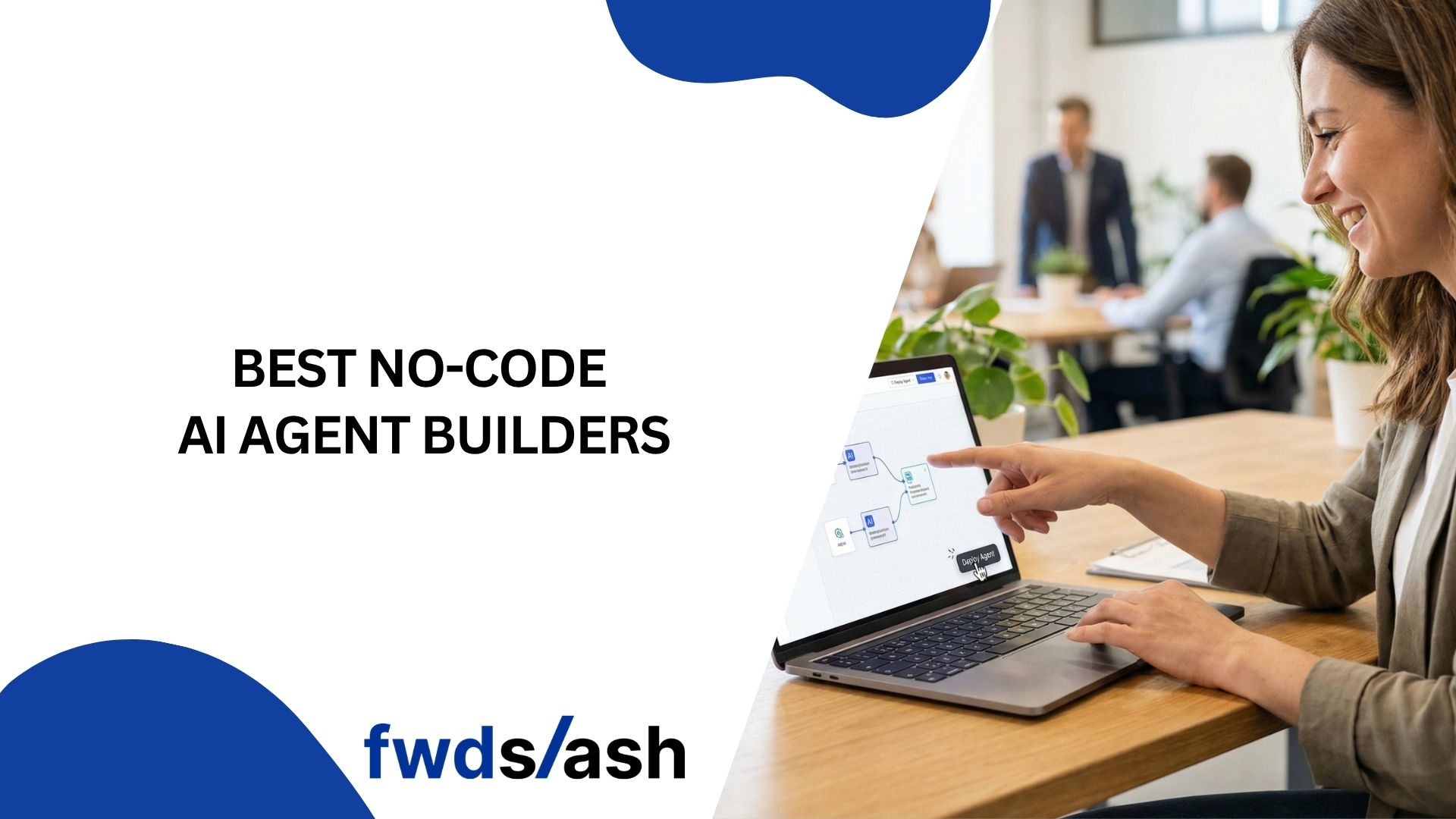
Every US business owner is asking the same question: how do I get AI agents working for my company without hiring a developer? The no code ai agent builder category is one of the fastest-growing software segments in 2026, and for good reason. These platforms let anyone create, train, and deploy intelligent AI agents using visual interfaces, drag-and-drop workflows, and natural-language prompts.
The global AI agents market reached $7.84 billion in 2025 and is projected to hit $52.62 billion by 2030 (MindStudio, 2026). Gartner predicts 40% of enterprise applications will embed task-specific AI agents by the end of 2026, up from under 5% in 2025. Meanwhile, 68% of US small businesses now use AI regularly (QuickBooks survey), up from 48% in mid-2024. The opportunity is massive, and the barrier to entry has never been lower.
Key Takeaways
- The no-code AI platform market is valued at $8.6 billion in 2026, projected to reach $75.14 billion by 2034 at a 31.13% CAGR (Fortune Business Insights).
- 95% of AI pilot programs fail to deliver measurable results, largely due to accessibility barriers that no-code tools eliminate (MindStudio).
- US enterprises forecast 192% ROI from agentic AI deployments, 3x higher than traditional automation (Landbase, citing PwC data).
- 91% of SMBs using AI report revenue growth, and 86% say it improved profit margins (BigSur AI).
- 74% of executives deploying AI agents achieved ROI within the first year (Google Cloud 2025 ROI of AI Report).
- Exploring small business AI agent advantages is critical before selecting a platform.
List of Best No-Code AI Agent Builders [Top 10]
Here are the top 10 no-code AI agent builders US businesses should evaluate in 2026, ranked by deployment speed, model flexibility, integrations, and real-world value.
1. FwdSlash
FwdSlash is an AI agent builder powered by Cyces AI that lets you deploy your AI agent in just 4 minutes. The platform offers multi-model support with OpenAI, Claude, and Deepseek, so you can compare models and pick what performs best for your audience. The setup process is simple: connect your knowledge (PDFs, web links, Google Drive, or sitemaps), pick the right model, design notifications, and deploy.
FwdSlash covers core use cases across automation and internal ops, sales, customer support, and marketing. Key features include built-in lead capture, fallback redirection to human agents, custom tool calls for connecting APIs and CRMs, crawl sitemaps for automatic knowledge updates, model comparison to test different LLMs side by side, and plug-and-play integrations with Slack, Zapier, WhatsApp, and Notion. It also supports scheduling and booking, internal workflow support, and customer support and FAQ automation.
FwdSlash publishes deployment guides for every major platform, including WordPress, Shopify, Webflow, Wix, BigCommerce, and HubSpot. You can also embed ChatGPT on any website or learn to train an AI chatbot with their step-by-step documentation.
Pricing: Free plan (1 AI agent). Intermediate at $20/month (1 AI agents). Pro at $100/month. Add-ons: additional messages ($10/month), additional agents ($15/month), remove FwdSlash branding ($20/month).
Best for: Small to mid-sized US businesses, ecommerce stores, agencies, and SaaS companies that need fast deployment with multi-model AI and built-in lead generation.
2. Zapier Central
Zapier leverages over 8,000 app integrations to add AI-powered steps into existing workflows. Use AI for text generation, data classification, and multi-step automations. However, pricing scales with task volume, and multi-agent coordination remains limited compared to dedicated AI agent platforms.
Pricing: Starts at $19.99/month, scales with tasks.
Best for: Teams already embedded in the Zapier ecosystem wanting to layer in AI capabilities.
3. Lindy
Lindy is designed for non-technical teams automating sales, support, and operations workflows. It features a visual block-based builder, multi-agent collaboration (separate agents handle lead qualification, follow-ups, and CRM updates), and SOC 2 plus HIPAA compliance.
Pricing: Free tier available. Paid plans start at $49.99/month.
Best for: US businesses in regulated industries like healthcare and finance that need compliance-ready agents.
4. MindStudio
MindStudio provides multi-model access within a single platform with built-in testing and evaluation tools. Teams can experiment with OpenAI, Anthropic, Google, and other LLM providers without switching platforms.
Pricing: Free plan available. Pro plans from $23/month.
Best for: Product teams that want model flexibility, rapid prototyping, and built-in analytics.
5. Botpress
Botpress combines an open-source foundation with a visual flow builder and autonomous AI engine. It supports multi-step logic with LLM reasoning, native live chat on paid plans, and Zendesk integration. JavaScript knowledge helps for advanced customizations but is not required for basic setups.
Pricing: Free tier available. Plus plan from $89/month (variable AI spend on top).
Best for: Tech-savvy teams building customer support chatbots that need deeper customization and multi-channel deployment.
6. Voiceflow
Voiceflow offers a visual drag-and-drop canvas for designing both chat and voice conversation flows. It supports multiple LLMs (GPT-4o, Claude, Gemini, Llama), a knowledge base with up to 3,000 sources on Pro, and native telephony via Twilio. Strong for teams building voice assistants alongside text-based agents.
Pricing: Free sandbox plan. Pro from ~$40/month.
Best for: Design-focused teams and agencies building complex conversational AI for both chat and voice channels.
7. Chatbase
Chatbase focuses on speed and simplicity. Upload documents, paste URLs, and have a working FAQ chatbot live in under 15 minutes. It supports AI Actions for connecting to external APIs, Zapier integration, and a solid analytics dashboard for tracking conversation performance.
Pricing: Free starter plan. Paid plans from $19/month.
Best for: Small businesses and startups that want the fastest path to a working AI chatbot without technical complexity.
8. n8n
n8n is an open-source workflow automation platform with AI agent capabilities. It offers self-hosting options, 130+ workflow nodes, and the ability to combine visual building with custom code for maximum flexibility.
Pricing: Free (self-hosted). Cloud plans from $24/month.
Best for: Technical operations teams that prioritize open-source control, self-hosting, and deep customization.
9. Tidio
Tidio combines live chat, chatbot flows, and AI automation (Lyro, powered by Claude) in one interface. It includes real-time visitor tracking, native Shopify and WooCommerce integration, and a shared inbox across email, Messenger, and Instagram. The built-in human handoff makes it practical for support teams that need both AI and live agent coverage.
Pricing: Free plan available. Paid plans from $29/month.
Best for: Ecommerce businesses needing an all-in-one live chat plus AI chatbot platform with strong Shopify integration.
10. Flowise
Flowise is an open-source drag-and-drop tool built on LangChain for building custom LLM applications. It supports conversational agents with memory, retrieval augmented generation (RAG), and cloud or on-premises deployment.
Pricing: Free (open-source). Hosting costs vary.
Best for: Developer teams wanting open-source flexibility with visual AI agent orchestration and RAG capabilities.
How Should You Choose the Right No-Code AI Agent Builder?
Selecting the right platform comes down to four factors.
Use case alignment. For customer-facing agents that capture leads and answer questions 24/7, FwdSlash offers the fastest deployment. For backend workflow automation across internal tools, Zapier or n8n may be a better fit.
Multi-model support. Platforms locked to a single LLM provider limit flexibility. The best no-code AI agent builders let you switch between OpenAI, Anthropic, Google, and others. FwdSlash, Voiceflow, and Botpress all offer multi-model options.
Integration depth. Your AI agent needs to connect with your CRM, email, and messaging stack. FwdSlash integrates with Slack, Notion, and Gmail, among other platforms.
Pricing transparency. Per-task and per-message pricing can escalate quickly. Always test with a free tier before committing budget.
What Are the Benefits of Marketing AI Agents for Small Businesses?
The advantages of marketing AI agents for small businesses go far beyond cost savings.
AI agents provide 24/7 customer support, which is essential for ecommerce and SaaS where response time impacts conversions. According to BigSur AI, 91% of SMBs using AI report revenue growth, while 87% credit AI with helping scale operations without proportional headcount increases. McKinsey research shows businesses using AI agents achieve up to 37% cost savings in marketing operations and 3% to 15% revenue uplift.
Lead qualification happens automatically inside conversations. Instead of static forms, agents ask targeted questions, collect information naturally, and route qualified prospects to sales. Human-AI collaborative teams have demonstrated 60% greater productivity than human-only teams (Warmly).
The core small business AI agent advantages include reduced support costs, faster response times, consistent brand messaging, and the ability to handle thousands of conversations simultaneously. In 2025, 80% of marketers reported AI tools exceeded their ROI expectations.
What AI Agent Statistics Should US Businesses Know in 2026?
The adoption data validates the investment case clearly.
- 79% of organizations now have some AI agent adoption, with 96% planning expansion (PwC, cited by Landbase).
- 25% of generative AI users launched agentic AI pilots in 2025, doubling to 50% by 2027 (Deloitte).
- 62% of companies expect to exceed 100% ROI from AI agent investments (Arcade.dev).
- 89% of CIOs consider agent-based AI a strategic priority (Futurum Group).
- North America holds 39.63% of global AI agents revenue (Grand View Research).
- 81% of consumers now see AI as a core part of customer service (Zendesk CX Trends).
No-code AI agents are not experimental technology. They are proven business infrastructure.
Conclusion
The no-code AI agent builder market in 2026 gives US businesses an unprecedented chance to deploy intelligent automation without technical complexity or large budgets. With enterprise apps embedding AI agents at scale and US companies projecting 192% ROI from agentic deployments, early adopters hold a clear competitive edge.
For businesses needing rapid deployment, multi-model flexibility, built-in lead capture, and seamless website integration, FwdSlash offers the best balance of simplicity and power. Start with the free plan, test on your website, and scale from there. You can also build an AI chatbot with a custom knowledge base using their guided process.
Start with one high-value use case, measure results, and expand. That is the playbook working for the most successful organizations in 2026.
Frequently Asked Questions
1) What is the best no-code AI agent builder for small businesses in 2026?
FwdSlash is a top choice because it combines deployment in just 4 minutes, a free starter plan, multi-model AI support (OpenAI, Claude, Deepseek), and built-in lead capture. It requires zero technical skills and integrates with WordPress, Shopify, Slack, and WhatsApp. Learn more about small business AI agent advantages.
2) How much does a no-code AI agent builder cost?
Pricing varies. FwdSlash has a free plan (1 AI agent), an Intermediate plan at $20/month (1 agents), and a Pro plan at $100/month. Chatbase starts at $19/month. Zapier from $19.99/month. Lindy from $49.99/month. Most platforms offer free tiers for testing before commitment.
3) Do I need coding skills to build an AI agent?
No. That is the core value proposition. FwdSlash, Zapier, Chatbase, Lindy, MindStudio, and Tidio are all designed for non-technical users. You build agents through visual interfaces, upload content, configure behavior, and paste an embed code to go live.
4) Can AI agents replace human customer support teams entirely?
AI agents augment human teams rather than replacing them. They handle repetitive questions, qualify leads, and deliver 24/7 responses. For complex issues, agents escalate to humans via Slack, email, or helpdesk tools. This hybrid model handles higher volumes without sacrificing quality.
5) How do I train an AI agent on my own business data?
Most platforms let you upload PDFs, Word files, website URLs, or sitemap links. FwdSlash imports your product catalog, FAQs, and documentation so the agent delivers accurate, business-specific answers. For a detailed walkthrough, see how to build an AI chatbot with a custom knowledge base.


Lastest blog posts
Tool and strategies modern teams need to help their companies grow.