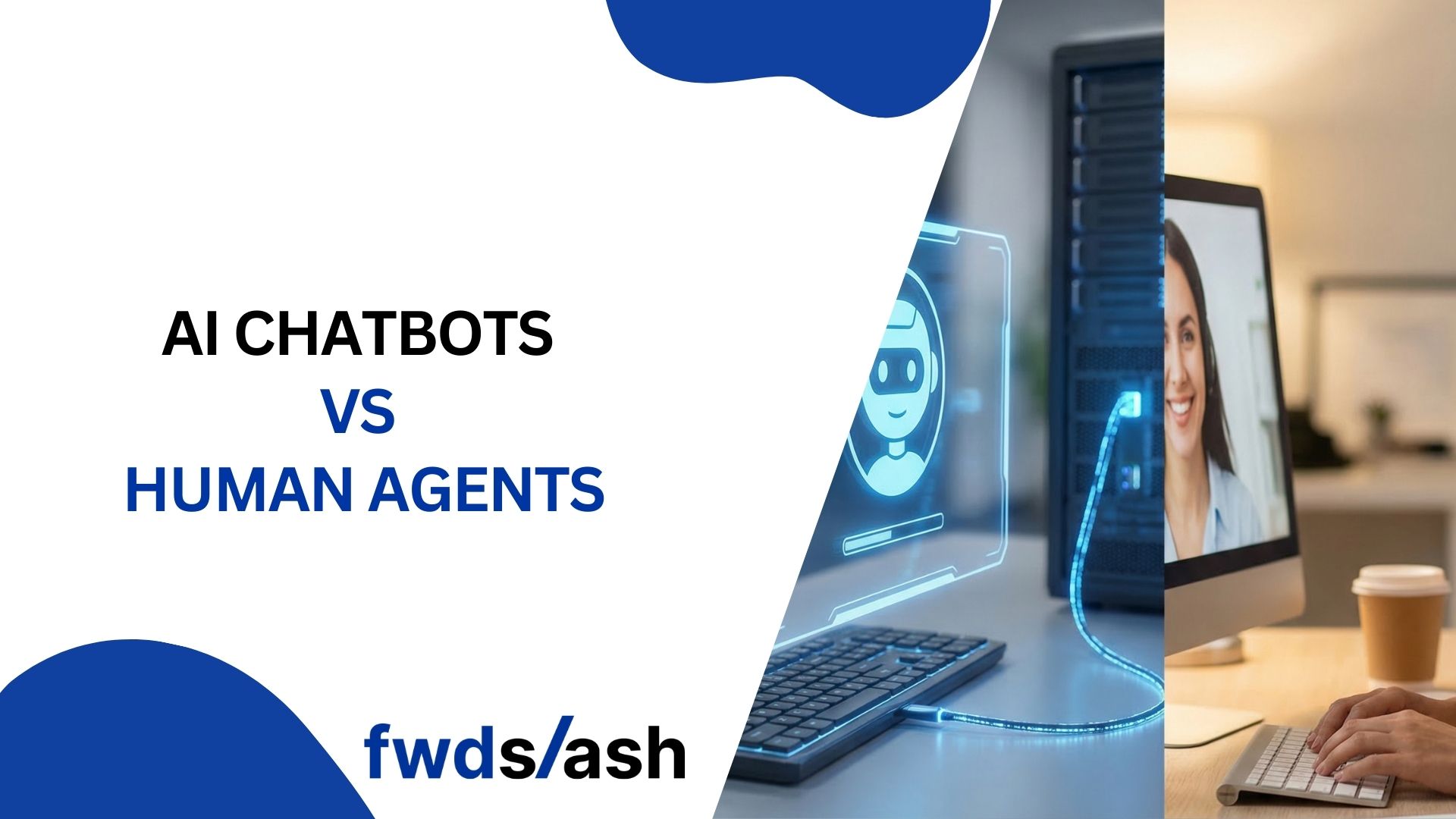
AI Chatbots vs Human Agents: An Honest Comparison (2026)
Every business owner faces the same question when scaling customer support: should you invest in AI chatbots, hire more human agents, or find a middle ground? With the global chatbot market projected to surpass $27 billion by 2030 and customer expectations at an all-time high, this decision has real financial and operational consequences.
This guide breaks down how do AI chatbots compare to human agents across cost, speed, customer satisfaction, and scalability. Whether you run a startup or a growing enterprise, this honest comparison will help you decide where to invest your customer service budget in 2026 and beyond.
Key Takeaways
- AI chatbots can reduce customer support costs by up to 30% while handling 80% of routine inquiries instantly.
- Human agents remain essential for complex, emotionally sensitive, and high-value customer interactions.
- The hybrid model (AI + human) delivers the best results, with companies reporting 85% success rates when combining both approaches.
- Small businesses see an average 300% return on investment within the first year of chatbot implementation.
- 82% of consumers prefer using a chatbot over waiting for a human agent, but 84% still want human support as an available option.
- Platforms like FwdSlash allow businesses to deploy AI agents in minutes, making hybrid support accessible even for small teams.
What Are AI Chatbots and How Do They Work in Customer Service?
AI chatbots are software programs powered by natural language processing (NLP), machine learning, and increasingly, generative AI models. Unlike the rule-based bots of the past that relied on scripted decision trees, modern AI chatbots understand intent, maintain conversation context, and deliver personalized responses.
These intelligent virtual assistants can handle tasks like answering FAQs, tracking orders, processing returns, scheduling appointments, and qualifying leads. Advanced platforms use retrieval-augmented generation (RAG) to pull answers from your specific knowledge base, achieving accuracy rates of 95 to 98% on domain-specific questions (Hyperleap AI).
If you want to understand how to train an AI chatbot on your business data, or learn how to build an AI chatbot with a custom knowledge base, these resources walk you through the process step by step.
How Fast Are AI Chatbots Compared to Human Agents?
Speed is where AI chatbots have a clear and measurable advantage. Chatbots respond in under a second, while human agents typically take several minutes during peak hours. According to industry research, AI chatbots can answer routine questions 80% faster than live agents (Adam Connell).
Consider these response time benchmarks:
- AI chatbots: Instant (under 1 second), available 24/7/365
- Human agents via live chat: 2 to 5 minutes average wait time
- Human agents via email: 4 to 24 hours average response time
- Human agents via phone: 53% of customers find waiting extremely frustrating, and only 18% are willing to wait 15 minutes
For small businesses that cannot staff round-the-clock support teams, deploying an AI agent is a practical solution. FwdSlash lets you add and embed ChatGPT on any website, giving visitors instant answers without the overhead of additional hires.
How Much Do AI Chatbots Cost vs Human Customer Service Representatives?
The cost difference between AI chatbots and human agents is significant. An average chatbot interaction costs around $0.50, compared to $6 to $40 for a human-handled support ticket depending on complexity (Elfsight). On a per-minute basis, AI costs roughly $0.03 to $0.25 versus $3 to $6.50 for human agents.
McKinsey's 2025 contact center analysis found that AI agents achieved a 50% reduction in cost per call while simultaneously improving customer satisfaction scores. Gartner projected that conversational AI would reduce contact center labor costs by $80 billion by 2026 (Fullview).
For small business AI agent advantages, the numbers are even more compelling. Small businesses report average returns of 300% within the first year of implementation, and collectively, AI chatbots help businesses save an estimated 2.5 billion working hours (Emulent).
With FwdSlash's transparent pricing (plans starting at $20/month), even bootstrapped startups can access enterprise-grade AI agent capabilities without the $50,000+ annual cost of a full-time customer service employee.
Do Customers Actually Prefer Talking to AI Chatbots?
Customer preferences around AI chatbots are more nuanced than the "humans vs robots" narrative suggests. The data reveals a clear pattern: people want speed for simple tasks and empathy for complex ones.
Here is what the research shows:
- 82% of consumers would use a chatbot rather than wait for a human agent
- 62% of respondents prefer engaging with digital assistants over waiting for human agents (Master of Code)
- 87.2% of consumers rate their chatbot interactions as neutral or positive
- However, 84% of consumers say human interaction should always remain an available option (Elfsight)
- 46% of customers still prefer human agents even when chatbots save time (Emulent)
Generational differences matter too. About 20% of Gen Z shoppers prefer starting with chatbots, compared to only 4% of Baby Boomers. Yet even among younger customers, over 40% of Gen Z and Millennials still prefer humans for complex issues (SpurNow).
The takeaway is straightforward: customers do not want to choose between AI and human support. They want both, working together seamlessly.
Where Do Human Agents Still Outperform AI Chatbots?
Despite remarkable advances in conversational AI, human agents maintain a decisive edge in several critical areas:
Emotional intelligence and empathy: When customers are frustrated, anxious, or dealing with sensitive issues (billing disputes, medical concerns, complaint escalation), they need someone who can read emotional cues, adjust tone, and provide genuine reassurance. AI can detect sentiment, but it cannot truly empathize.
Complex problem solving: Situations that fall outside standard procedures, such as unique product malfunctions, unusual account issues, or multi-step troubleshooting, require the creativity and contextual judgment that only human agents can provide.
Relationship building and retention: For high-value accounts, VIP customers, or situations where brand loyalty is at stake, human agents create the personal connections that drive long-term retention.
Handling ambiguity: When a customer's request is unclear, contradictory, or requires reading between the lines, human agents use experience and intuition to navigate the conversation effectively.
Research consistently shows that roughly 80% of support inquiries are repetitive or simple, while 20% require human judgment. The smartest approach routes each type to the right channel automatically.
Why Is the Hybrid AI and Human Model the Best Approach?
The data overwhelmingly supports a blended strategy where AI chatbots and human agents work together rather than compete. Companies implementing hybrid models report 85% success rates, significantly higher than either pure AI or human-only approaches (Emulent).
Here is how the hybrid model works in practice:
- AI handles the first touch: Chatbots greet customers, answer common questions, and resolve routine issues instantly.
- Smart escalation: When a conversation requires human judgment, the AI seamlessly transfers the customer to a live agent along with full conversation context.
- AI assists human agents: Even during human-handled interactions, AI provides agents with customer history, suggested responses, and relevant knowledge base articles.
- Continuous learning: Every interaction feeds back into the AI system, improving accuracy and reducing future escalation rates.
Companies embracing this augmented approach report 23% higher agent satisfaction and 18% lower turnover compared to traditional customer service operations (WorkHub AI).
Only 13% of AI chatbot conversations require escalation to human agents, a 60% reduction from traditional chat support (Hyperleap AI). This means your human team can focus entirely on the interactions that truly need their expertise.
How Can Small Businesses Get Started with AI Customer Support?
The biggest misconception about AI chatbots is that they require massive budgets and technical teams to implement. Modern platforms have eliminated these barriers entirely.
FwdSlash, for example, lets you deploy a fully functional AI agent in under 4 minutes. You connect your knowledge base (documents, FAQs, product catalogs), customize the agent's behavior, and deploy it across your website, Slack, or any platform your customers use.
Here is a practical roadmap for small businesses:
Step 1: Audit your support volume. Identify the repetitive questions your team answers daily. These are your automation candidates.
Step 2: Build your knowledge base. Compile your FAQs, product documentation, policies, and common troubleshooting guides.
Step 3: Deploy your AI agent. Use a platform like FwdSlash that supports multi-model AI (OpenAI, Claude, Deepseek) and integrates with your existing tools. You can integrate ChatGPT into WordPress, Shopify, Webflow, Wix, HubSpot, or BigCommerce.
Step 4: Set up escalation rules. Define when the AI should hand off to a human and ensure agents receive full conversation context.
Step 5: Monitor and optimize. Track resolution rates, customer satisfaction, and escalation patterns to continuously improve your AI agent's performance.
For teams already using collaboration tools, FwdSlash also supports Slack integration, Notion integration, and Gmail integration, so your AI agent works wherever your team already operates.
What Are the Best Use Cases for Marketing AI Agents for Small Businesses?
Beyond customer support, marketing AI agents for small businesses are transforming how companies generate and convert leads:
- Lead qualification: AI chatbots engage website visitors in real time, ask qualifying questions, and route hot leads directly to your sales team. Chatbot-generated leads convert at three times the rate of traditional sign-up forms (Emulent).
- Cart abandonment recovery: E-commerce chatbots reduce cart abandonment by 20 to 30% by re-engaging customers who leave before completing a purchase (DemandSage).
- Product recommendations: AI agents analyze browsing behavior and purchase history to suggest relevant products, increasing average order value.
- Appointment scheduling: Service-based businesses automate booking through conversational interfaces, eliminating back-and-forth emails.
- After-hours engagement: 40% of chatbot users appreciate getting support outside business hours, capturing leads and answering questions while your team sleeps.
What Does the Future of AI Customer Service Look Like?
The trajectory of AI in customer service is accelerating rapidly. By 2027, Gartner predicts 25% of organizations will use chatbots as their primary customer service channel. McKinsey projects that 20 to 30% of service agent positions will be replaced by AI by 2026, while new roles for AI trainers, conversation designers, and automation specialists are being created.
Key trends shaping the future include:
- Agentic AI: Chatbots evolving from answering questions to autonomously completing tasks (processing refunds, updating accounts, booking services)
- Multimodal interactions: AI agents processing text, voice, images, and video within a single conversation
- Proactive support: AI predicting customer issues before they arise and reaching out with solutions
- Hyper-personalization: AI using real-time data to tailor every interaction to the individual customer's history and preferences
Businesses that adopt AI customer service now will gain significant competitive advantages. Those that wait risk falling behind as customer expectations continue to evolve.
Conclusion
The question is no longer whether AI chatbots are better than human agents or vice versa. The evidence is clear: the most effective customer service strategy combines the speed, scalability, and cost efficiency of AI chatbots with the empathy, creativity, and judgment of human agents.
For small businesses, the barrier to entry has never been lower. Platforms like FwdSlash make it possible to deploy AI agents in minutes, not months, with pricing that works for businesses of every size. Whether you need to handle customer support queries, qualify leads, or automate internal workflows, the hybrid AI-human approach delivers measurable results: lower costs, faster response times, and happier customers.
Start with the 80% of routine inquiries that AI handles well, keep your human team focused on the 20% that truly matters, and build from there. Your customers and your bottom line will thank you.
Frequently Asked Questions
1) Can AI chatbots fully replace human customer service agents?
No. AI chatbots excel at handling routine inquiries, FAQs, and repetitive tasks, but human agents remain essential for complex problem solving, emotionally sensitive interactions, and situations requiring creative judgment. The most successful companies use a hybrid model where AI handles roughly 80% of inquiries and humans manage the remaining 20%.
2) How much money can a small business save by using AI chatbots?
Small businesses typically see a 300% return on investment within the first year. The average chatbot interaction costs about $0.50 compared to $6 to $40 for human-handled tickets. Collectively, AI chatbots help businesses save an estimated 2.5 billion working hours and can reduce customer support costs by up to 30%.
3) How do AI chatbots compare to human agents in terms of customer satisfaction?
Customer satisfaction depends on context. For simple, routine questions, customers overwhelmingly prefer the speed of chatbots, with 82% choosing a chatbot over waiting for a human agent. For complex or emotional issues, human agents deliver higher satisfaction. Companies using hybrid models report the highest overall satisfaction scores.
4) What is the easiest way to add an AI chatbot to my website?
Platforms like FwdSlash allow you to deploy an AI agent in under 4 minutes. You simply connect your knowledge base, configure the agent's responses, and embed it on your website. FwdSlash supports direct integration with WordPress, Shopify, Webflow, Wix, HubSpot, BigCommerce, and more, making setup accessible even without technical expertise.
5) Will AI chatbots get better at handling complex customer issues?
Yes. AI technology is advancing rapidly. By 2027, multimodal AI agents will process text, voice, and images within single conversations. Agentic AI will move beyond answering questions to autonomously completing tasks like processing refunds and updating accounts. However, human agents will continue to play a critical role in high-empathy, high-stakes interactions for the foreseeable future.


Lastest blog posts
Tool and strategies modern teams need to help their companies grow.